Guide
Why Your Commercial Ice Machine Slows Down (and the Descaling Fix)
Low ice production and thin cubes are usually scale, not refrigerant. How descaling and NSF sanitizing keep a commercial ice machine producing and compliant.
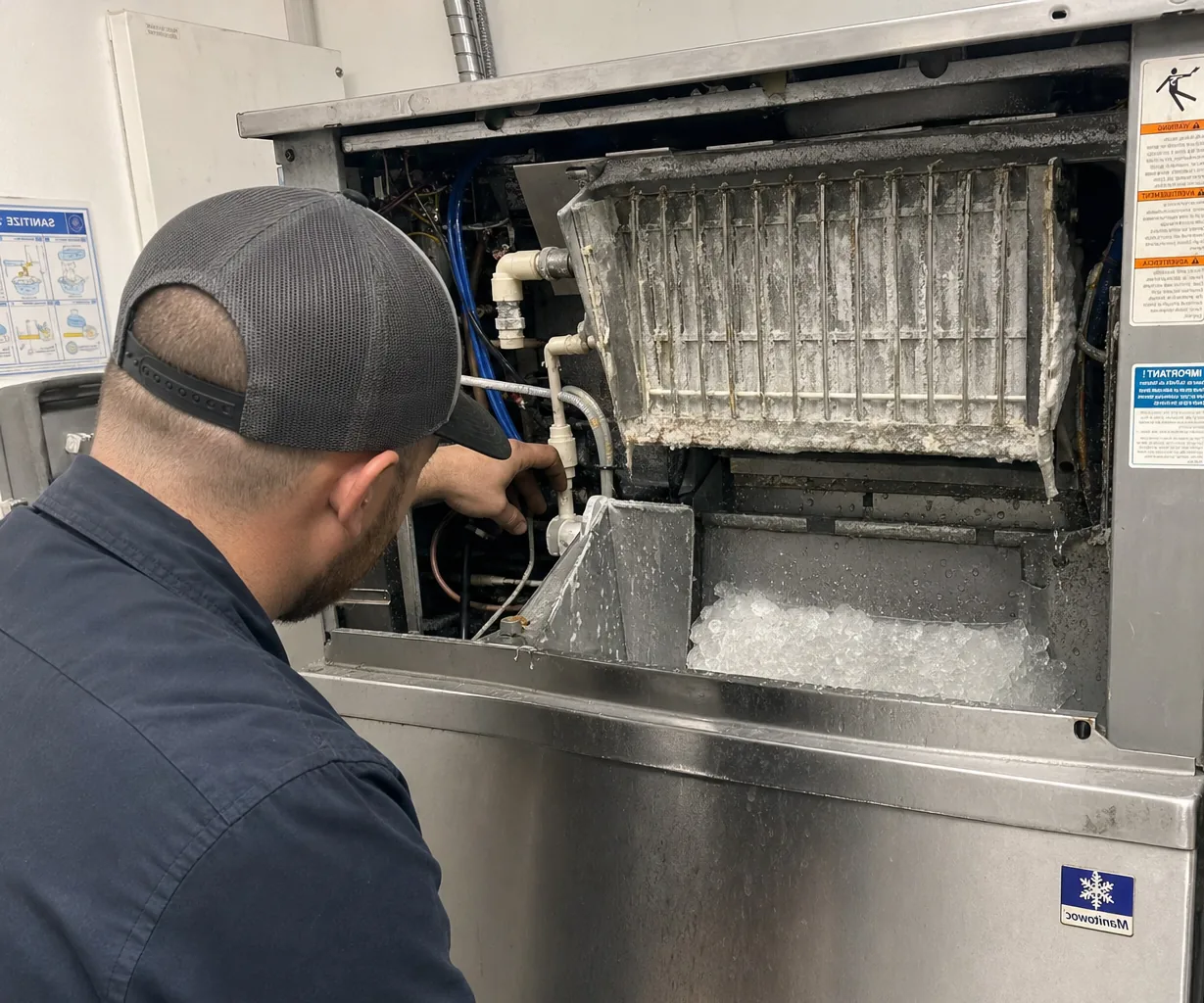
For a bar or restaurant, no ice means no service. So when a commercial ice machine starts making less ice — or the cubes come out thin, cloudy, or misshapen — operators often assume the worst: a failing compressor or a refrigerant leak. In reality, that’s rarely the cause. An ice machine is a water appliance first and a refrigeration appliance second, and the overwhelming majority of production complaints come down to one thing: scale.
How scale kills an ice machine
Every commercial ice machine pushes huge volumes of local water across a metal evaporator. Northern New Jersey’s water leaves mineral deposits — scale — that build up on that evaporator over time. As scale accumulates:
- The evaporator can’t transfer cold efficiently, so freeze cycles get longer and production drops.
- Cubes form thin, cloudy, or misshapen because the water isn’t freezing cleanly.
- The water inlet valve and float wear faster fighting through mineral buildup.
- Energy use climbs as the machine works harder for less ice.
Chasing the sealed system when the real problem is scale is how a lot of money gets wasted. A proper deep descale usually restores full production and clean cube quality — no refrigerant work required.
The biofilm problem (and your health inspection)
Scale isn’t the only thing growing inside a neglected ice machine. Wherever sanitizing gets skipped, biofilm — the pink or gray slime you sometimes see inside the bin or on the evaporator — takes hold. It fouls the harvest cycle, and it’s a direct food-safety and health-inspection failure. Ice is a food, and an inspector who finds biofilm can write you up on the spot.
That’s why proper ice-machine service is always two jobs: deep descaling to restore production, and NSF-compliant sanitizing to keep the ice safe and you inspection-ready.
The schedule that keeps ice flowing
- Deep descale and sanitize every 6 months at minimum — quarterly in hard water or high-volume operations.
- Replace water filters on schedule to slow scale and protect the inlet valve.
- Keep the condenser clean so head pressure stays low and freeze cycles stay short.
- Watch for early warnings: declining production and misshapen cubes mean scale is already building.
- Never store product or scoop with glass in the bin — contamination and breakage risk.
When to call
If your Hoshizaki, Manitowoc, or other commercial machine is producing less than it should, making poor cubes, or showing any slime inside, don’t wait for it to quit before a busy night. A documented deep descale and sanitize is usually all it takes — and it keeps you both producing and compliant. Call our dispatch line for same-day ice-machine service and scheduled descaling across Hackensack and Bergen County.